Building Better Self-Trust: Tangible Steps

Image via Flaticon.
This is the final installment of a three-part series on self-trust.
If you’re here, I hope that means parts one and two of the self-trust series were helpful to you! In part one, you worked to grow your awareness around thoughts, feelings, behaviors, and physical sensations that signal self-mistrust. In part two, you identified beliefs that keep you from trusting yourself. Below we’ll explore tangible steps you can take to build a sturdier foundation of self-trust.
Note: In the previous installments of this series, we also addressed the difference between healthy mistrust of others and chronic unhealthy mistrust of self, as well as a systemic lens and how systems play a role in fostering a lack of trust in ourselves. These are really important pieces of the puzzle to address! Please refer back to part one and part two to learn more, especially if you’re getting stuck.
Building Better Self-Trust
Relationship challenges, indecision, and avoidance all often share a similar root: lack of self-trust.
When you can’t believe your own instincts and feelings, it’s hard to build the kind of life you envision for yourself. This leads to feeling on guard — hypervigilant to all the ways others and the world can cause you harm. Especially when you’re not sure you can count on yourself to pick up the pieces.
The good news is there are tangible steps you can take to build a better relationship with yourself, learning to lean on your own instincts, thoughts, and feelings when things get hard. And they’re all things that are within your control!
Step one: tapping into Awareness
Mindfulness After Trauma
The first step, as always, is building awareness. A few factors make this challenging.
First of all, if you’re a trauma survivor, you might notice that it’s hard to be present. Following traumatic events, our brain’s protective mechanisms for fight, flight, and freeze can kick in without our choice or awareness. Whether it’s the need to stay constantly busy and go, go, go, or feeling stuck and dissociated, you struggle to be still with what’s happening in and around your body.
When you’re disconnected from your body, you’re more vulnerable to self-mistrust, as well as being swayed by the influence of others. Before we outline how to be here-and-now with your body, an important caveat: if dropping into your body with presence brings up overwhelming feelings or unhelpful impulsive urges, you may want to pause this part until you can meet with a qualified trauma therapist. Therapy can help you build a gentler entry ramp to access your overwhelming feelings.
Practicing Awareness
Dropping into your body and mind in a present way has so many documented benefits. Whether you’re hoping to address chronic pain, depression, anxiety, or mistrust, it’s a vital skill that can bring so much insight. In fact, the present is the only time you can actually change your life, as the past has already happened and the future hasn’t arrived yet. Being in the moment allows you to make more aligned choices and decisions, moving you toward the life you are longing for.
Not everything listed below will be a fit for you. I recommend experimenting to learn what feels most supportive for your body and mind.
Start with your breath
It probably sounds surprising, but the sessions in which my clients take time to slow down and focus on their breath are some of the most impactful. Of course we do plenty of talking in therapy too, but attending to the body in the here-and-now is a lost art. It’s an absolute honor to get to help people get back in touch.
Almost immediately if you start to focus on your breath, you will probably start breathing deeper than you are now. And while there are benefits to breathing deeper, forcing it may cause us to miss important insights. If you’re trying to build better self-trust, try and see if you can notice your breath, just as it is now, without trying to change anything about it.
Noticing Your Breath — Guiding Questions
What is the quality of my breath?
How deep or shallow is my breath?
How fast or slow is my breath?
Are there pauses between my inhale and exhale or exhale and inhale?
What is the first place I notice my breath in my body? (Nostrils, throat, chest, lungs, stomach, back, somewhere else?)
How does the rest of my body feel when I’m breathing this way?
Does my breathing change when I sit with it and notice it this way, even without me trying?
How do I feel after this exercise versus before? (If the same, notice that; if different, notice what specifically has changed)
Experiencing Your Body
If you’ve survived trauma, your body may not feel like a safe place. Often clients with trauma and chronic illness feel betrayed by their body. This is such a valid response! And, our bodies, even when they don’t feel like it, are maybe our most important resource. Even a body that betrayed me is still keeping me going. Lots of feelings come up around body work. Be gentle with yourself and skip if you’re not ready! (That’s another great way to trust yourself — knowing what you feel ready for and honoring that, knowing you can come back anytime.)
Last caveat: some people have tapped out of their body either because that’s what their culture demands or as a survival response to what they’ve been through. If it’s really hard to experience or notice physical sensations, maybe start with something bigger versus smaller. (Ex: taking a big stretch versus being still while trying to notice physical sensations.)
Starting Smaller
Pause and notice your body language right now. Just like the previous exercise, see if you can notice without immediately shifting or changing. Simply taking stock can give you clues about your default setting! Once you’ve taken note, feel free to move to the position that feels best for you.
Scan your body for anything that feels supportive. Are your legs crossed, or open? What is your point of contact with the ground (two flat feet, the point of one toe if your legs are crossed, your sacrum if you’re sitting on the ground)? What are your hands doing (are they in contact with your body? Are they in contact with each other?)
Once you’ve noticed a bit about your body language, start to tune into which feels either neutral, best, or least bad. I’m currently in a somatic training with Dr. Abi Blakeslee who wisely notes that sometimes nothing really feels “good” but certain things may feel less bad.
Once you notice the part that feels good, neutral, or less bad, pause with it. Lean into it. Try to soak it up. Notice what happens in your body when you’re paying attention to this support. Take note of the fact that your body knew you needed this and offered it to you! See if you can carry some aspect of this feeling with you into the next part of your day.
Our brains have a negativity bias. That’s why when you have a toothache, your tongue keeps returning to the one tooth that hurts, and the other 31 teeth go totally unnoticed. We’re wired to notice the bad so we can fix it. That’s not a bad thing — it’s so good for survival! If you ignored that painful tooth, you could miss important information to maintain dental health and it could get much worse. However, negativity bias is also good at making and keeping us depressed.
By practicing “starting smaller” above, you’re building trust with your body just by being in it and noticing how it can support you — something we so often overlook without a lot of practice. The more you practice, the more data points you’ll have. For example, if you practice now when you’re reading this, you may be feeling activated or neutral, or engaged in learning. But if you practice this when you feel annoyed or a little disappointed, you will likely notice your body doing something else that feels supportive. This is good information! You may think, “ahh, so when I’m learning and calm my body likes to rest my chin in my hands, but when I’m anxious or irritable, it really wants me to put my hands on my stomach and chest with medium pressure.” Then the next time you feel those ways, you’re more likely to engage in those supportive behaviors. With practice, this can become automatic.
Think of all the ways we behave when we’re upset and emotionally hijacked that lead to regret later. By tuning into your body and trusting it, you start to rewire those responses. Additionally, the more time you spend in your body, the easier it will be to tell whether it’s giving you an anxious/fear response out of habit, or if that’s your gut wisdom talking. Learning to listen to your gut is getting at the center of trust. You can feel it!
Step Two: Behavior change
After we’ve built awareness and feel able to stay in the present, we’re better set up to make behavioral changes. These are the tangible impacts we can have on external factors of life. Feeling empowered to change your behavior and count on yourself to act in alignment with your values can lead to improved self-trust.
Leverage Your Values
Like all of these skills, there’s so much more than I can include in this one blog post. Here’s a quick and dirty explanation of values from Acceptance and Commitment Therapy (ACT), including a list of common ones you can mark up to learn more about yourself.
Values are those internal guide posts for life, different from goals, which serve to remind us if we’re heading in the right direction. When we do something that goes against our values, it creates internal discomfort, perhaps regret, and even sometimes leads to shame. When we behave in ways that align with our values, we usually feel more connected to ourselves and satisfied. Our brains like it! Usually this moves us closer to the type of life we want to live and person we want to be. Sounds important for self-trust, right?
Choice Point Model
Once you’ve identified your values, it becomes clearer which behaviors support or detract from them. A great tool to map out values-based decision making is the Choice Point Model (also from ACT!).
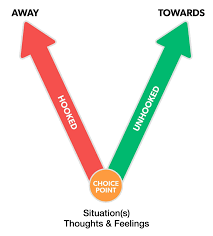
First let’s get oriented wtih this little illustration. At the center in yellow, you see the words “choice point.” Every time we have an opportunity to move toward or away from our values, that is a choice point. So let’s say I’m trying to prioritize my physical health by exercising more regularly. I value health and wellness, taking care of myself so I can be there for others. After work when it’s time to decide whether to watch another episode of High Potential or do my weight training, that is a choice point.
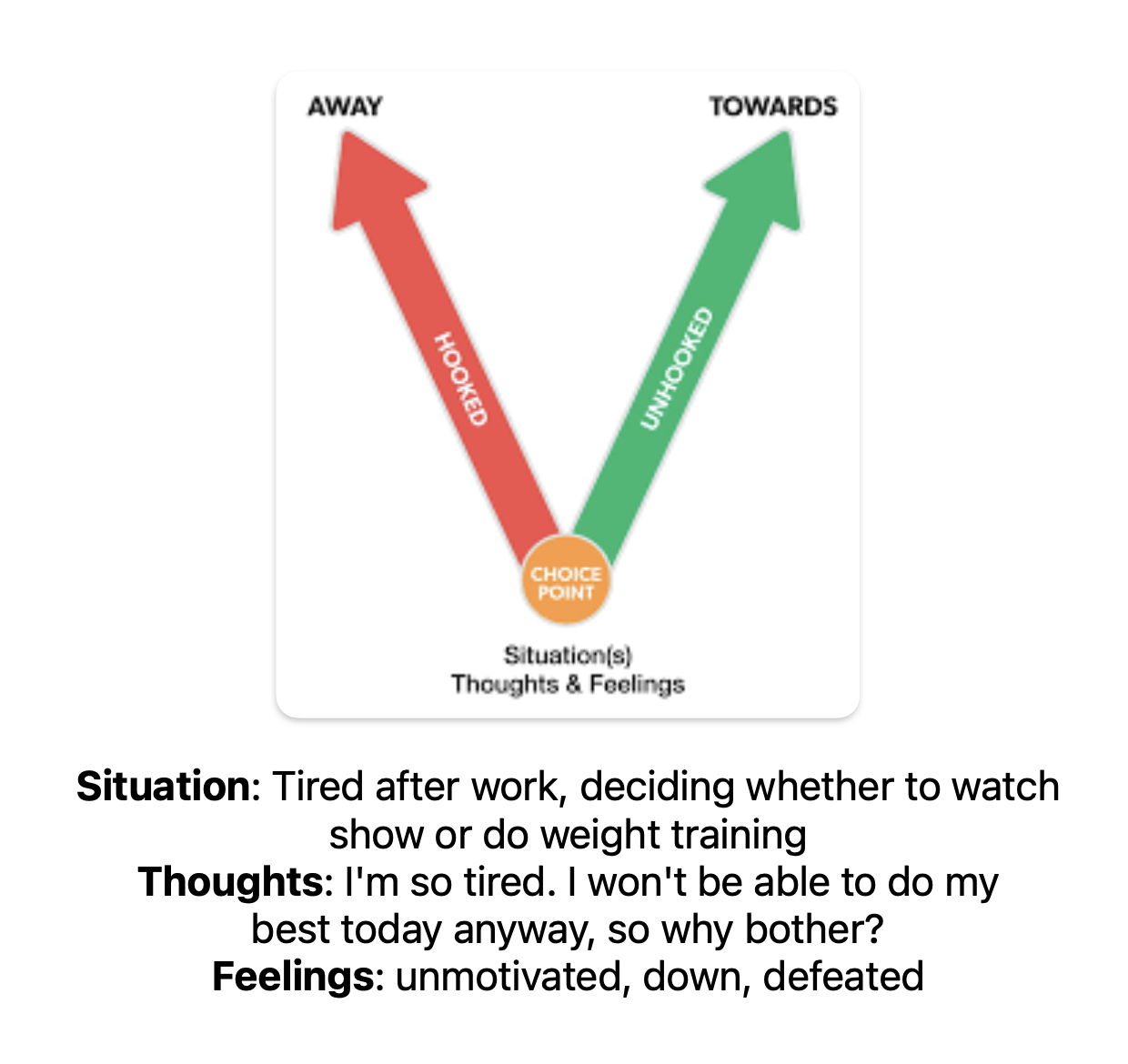
So using this example, I would write out the situation, my thoughts, and feelings under the “choice point” circle.
Looking at each of the arrows, we can see that I have a chance to move toward or away from my values based on my behaviors. The words “hooked” and “unhooked” reference the thoughts and feelings that often reel us in, pulling us toward or away from moves we want to make.
If you look at my thoughts and emotions here, you can see I’m hooked — my thoughts and feelings are hooking me to pull me away from my values in this situation.
According to ACT, for most of us, our default setting is to become hooked and engaged in away moves.
Learning to recognize when we’re hooked, get unhooked, and engage in more “towards moves” builds greater self-trust over time.
So how do I get unhooked? Below I am checking in on what away moves would look like. I wrote out some examples in this case. On the right hand side I wrote my goals (which align with my values) as well as some “towards moves” I might be able to take. Notice the “towards moves” are not perfect, they are small steps! Just because I don’t complete an entire workout doesn’t mean I engaged in away moves. I’m still taking small steps toward my values that may result in more motivation and positive feelings later.
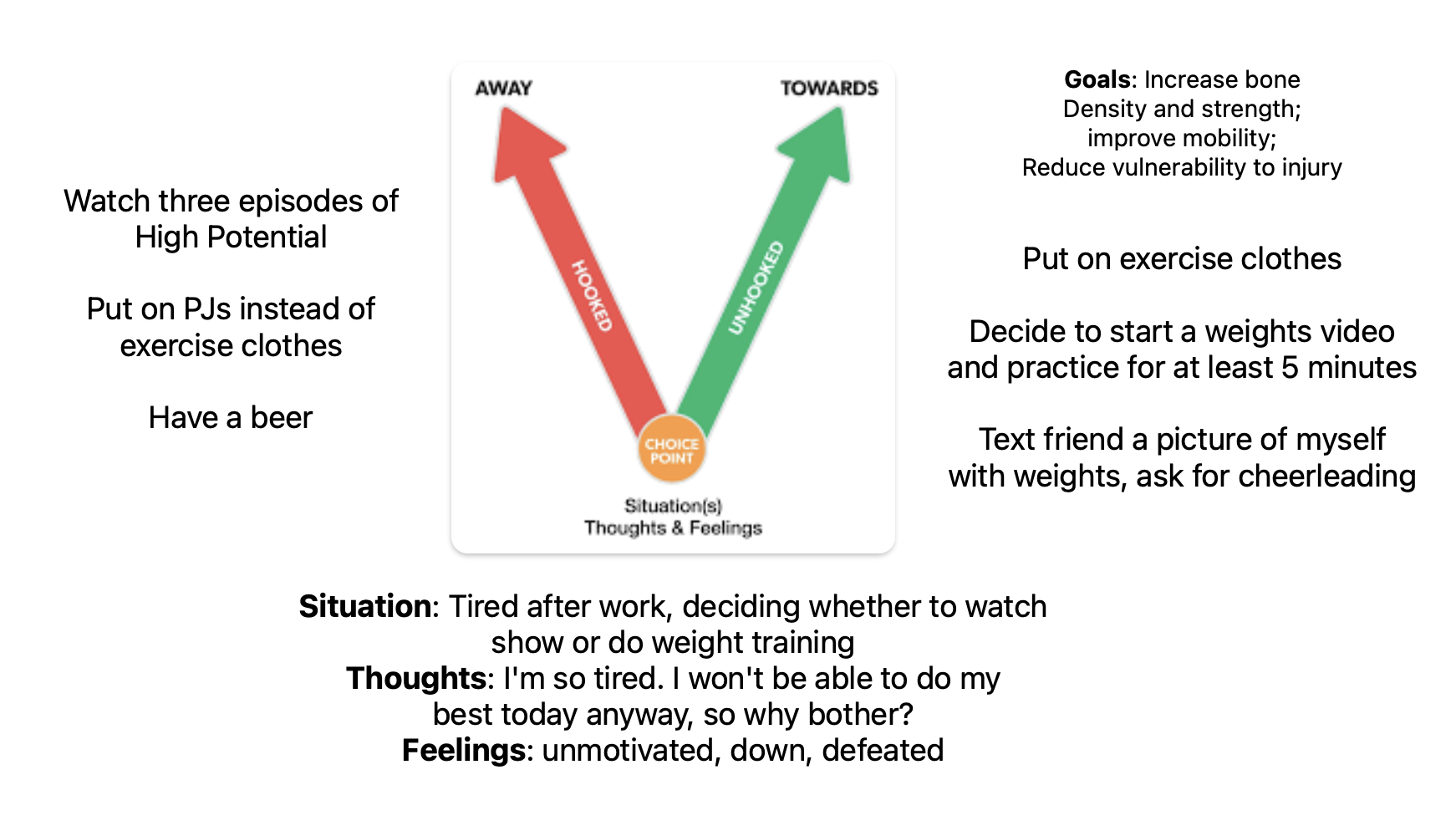
example of a filled out Choice Point Model
Let me be real: this is an over-simplified example! We could also argue that I value rest and self-care, important facets of fitness! In that case, my “towards moves” would look very different. There’s so much nuance we’re skipping over in a blog post. My hope is you can take this skill and examine in greater detail the ways in which you become hooked and how you might be able to engage in small, steady “towards moves.”
The more you live in alignment with your values in everyday scenarios, the sturdier your sense of self will feel, bolstering self-trust! This allows you to lean on yourself for support when bigger, more consequential decisions are on the table.
Experimenting with Trust
Okay, if you’re here you probably don’t trust yourself as much as you’d like to. One way to rewire that instinct is to just go for it. This is easier said than done, and you’ve probably thought of this before and maybe even tried it. Still, if the above or below options feel too heady or labor-intensive, just ripping off the band-aid might work for you.
I once worked with a client who struggled with overthinking how she appeared online. She would go to post something, then get caught up in worries about others’ judgments and wind up not saying anything. A goal of hers was to be more authentic, so we talked about this approach of just going for it. Starting with something that feels lower stakes can help you get started. Maybe it is as simple as just posting a selfie with no caption. Or sending a text asking if someone wants to get coffee. See what it’s like to act on the instincts you trust just a little bit at a time every day. Note what goes well and what feels like it doesn’t work out. Be sure to challenge any distorted thinking that might arise around your expectations and the outcomes.
If you’re lost as to where to start, you might try experimenting with asking for what you need or saying no. There was a bit more about this in Part 2 if you’d like to dive in deeper.
This will feel weird at first, maybe even wrong! You have received so many messages of wrongness, incompetence, and inadequacy in your life. One way to challenge these messages is to practice acting on your instincts, which will help you test your limits and build a tolerance for the fear that comes right before doing what you think you should.
Step 3: Check in with Your Thoughts
Of course much of our struggle with self-trust is wrapped up in the way we think of ourselves. If I believe I’m untrustworthy or I can’t do something, that’s likely to continue if unaddressed. The skills above of dropping into the present moment can inherently begin to build self trust as you get comfortable inside your own skin, and check in on behaviors you’d like to change. But addressing the thoughts directly is also so helpful.
Inventory Negative Self-Trust Thoughts
I’ll refer you back to part 2 of this series for this step! If you haven’t, read over the common self-mistrust thoughts, noting which ones resonate most with you. There are already some tools within that section that address the thoughts specifically. Just becoming aware of your patterns is already a huge step! Once you’ve noted some of your unhelpful thoughts, here are some questions you can ask yourself that might help them become less stuck. The points below are adapted or lifted from Cognitive Processing Therapy (CPT).
Challenging Your Thoughts
What emotions does this thought bring up for you? How big are they?
Is this thought 100% true? What % true does it feel right now? Write out which parts are 100% true and which parts aren’t.
Is this thought 100% helpful? How helpful does it feel right now? Write out what’s helpful and unhelpful about it (hint: helpful thoughts lead to emotions and behaviors that help us meet our goals and align with our values).
Do I have a habit of thinking this way? Is this a common thought or type of thought for me to have?
For example, if I’m often very hard on myself, is this thought also hard on me? If I often blame others and struggle to take responsibility, does this thought fall into that pattern?
Are there important details I’m leaving out? Am I ignoring important parts of this situation?
Is my thought predicting the future? If so, in what way?
Is my thought assuming I can read other people’s minds? (ex: if I say that, they’ll be so mad and stop talking to me.)
Where does this belief come from for me? (systems of oppression, parents, religiosity, media, myself, friends…etc)
How would I act if I didn’t believe this thought?
What would a more helpful, accurate thought be? If I could just implant a new belief into my brain, what would I want to believe about myself, others, or this situation?
What emotions do you feel when you tell yourself this new, accurate and helpful thought? How big do they feel?
Examining our thoughts like this can be really uncomfortable. Sometimes thoughts that are causing problems today were really helpful in the past. They may even still be helpful now, but they also come with harmful effects at the same time. For example, if I think, “I can’t get close to other people or they’ll hurt me,” that could be considered helpful — it probably does keep me from getting hurt by others if I’m not so close to them. However, if I value close, authentic relationships, this thought is simultaneously stopping me from an important life goal. You get to decide what’s helpful or harmful to you right now. The questions above help you do this with open eyes.
Highlight What Went Right
Because of the negativity bias referenced above, we tend to over prioritize and remember the times things went wrong versus when they went well. But if you are a human being on this planet, I guarantee you have done things you thought you couldn’t do at some point in life. You’ve stretched and grown in ways you never knew you could, just by nature of being here. Our brain likes to overlook that, so let’s refocus on it for a bit!
Journal Prompt
What’s something you didn’t think you could do, but you ended up doing anyway? This may be enough to get you going, but if you need follow up questions, see below. Skip any that don’t apply:
Describe the situation you thought you couldn’t handle or the task you thought you couldn’t complete.
What were your thoughts about this before you did it? Write out the beliefs about why you thought you couldn’t do it/wouldn’t be able to handle it. Try to be specific.
What emotions did these thoughts bring up for you at the time? How did you feel toward yourself? Others?
Does my self-doubt serve a purpose? What might that be? Are there good things about feeling stuck here (no judgment!)?
What made you keep moving anyway? Maybe you thought you had no choice. Why was that? It’s hard to admit, but we usually have some choice, even if it’s not a choice we like. Can you identify the choice you made here?
How did you get through the situation? What went well or better than expected? What do you wish went differently? Is there anything you could have done to make that happen? Why or why not?
What qualities or attributes helped you in this situation? If it’s hard to identify your own attributes, look outside yourself and ask: what types of qualities does someone have to have to get through such a situation?
Would I have behaved differently if I believed I could do this from the start? How so?
If you could go back to when you were doubting whether you could do it, what would you tell yourself? What would you want someone in a similar situation to know?
After writing out your answers, depending on the situation, you could use what you write as a template the next time you doubt you can do something. Even something small (I can’t get up five minutes earlier every day — okay maybe that’s not so small, if you’re me!). In fact, starting with things that feel more mundane, those everyday “boring” choices, may feel more approachable than huge life changes. The more you do it everyday, the easier it will become when it feels like a lot’s on the line.
Imagine Trusting Yourself
If journaling and writing aren’t your thing, and the above mindfulness exercises feel too general, here’s something super specific. I’ve heard that dreams are our mind’s way of practicing for things that might be stressing us out. If you’ve ever had a stress dream before giving a presentation, you know what I mean! In this exercise, we’ll be doing something like that, but with the conscious mind.
Try to call to mind a situation in which you’re struggling to trust yourself. Maybe it’s an important conversation you want to have but you’re worried it’ll be hard. Or you want to try and introduce a new daily habit that aligns with your values. Or you have a big paper or presentation due soon and you’re feeling a lot of self-doubt. Whatever the situation is, you can tailor this exercise to fit your needs.
Step by step
We spend so much time imagining what may go wrong. Let’s dive in and intentionally imagine how it might go right.
Call to mind the situation in which you’re experiencing self-doubt or mistrust. Imagine yourself at the crucial point of that situation. If that’s fear of starting a difficult conversation, you’re imagining yourself actually in that conversation. If it’s the presentation, imagine you’re giving it from start to finish. In this exercise, try and imagine it going as well as possible, whatever that looks like.
Imagine the situation going well in as much detail as possible. Who’s there? What are their facial expressions? What’s yours? What are you wearing? How are you standing or sitting? What are you saying? What’s your body language like? How is your breathing? What’s your tone of voice? Try to map it out as clearly as possible.
Now check in with your body in the present. How does it feel to be with this image? What happens in your body? Any areas of tightness and tension, areas of calm and relaxation? Notice and try to breathe with them. They’re not bad, they’re just cues from your brain about how you feel.
What is enough?
This post is so long! If you made it to the bottom, kudos! It means you really care about building these skills. There are so many more to share!
I plan to compile a Self-Trust Resource Roundup and share that in the coming weeks as well. It will include names of skills (the ones in this series and more that I didn’t get to include), a brief description, and links to more detailed explanations. I’ll also include podcasts, books, and social posts that fit this theme and provide a deeper dive into aspects of this topic I didn’t get to.
Feel free to comment with the self-trust building skill you are going to try first! This might inspire those who are stuck and give them an idea of a good place to start. As always, thank you for reading!